American Dancer: “Showcasing Female Power in Ballroom Dancing”
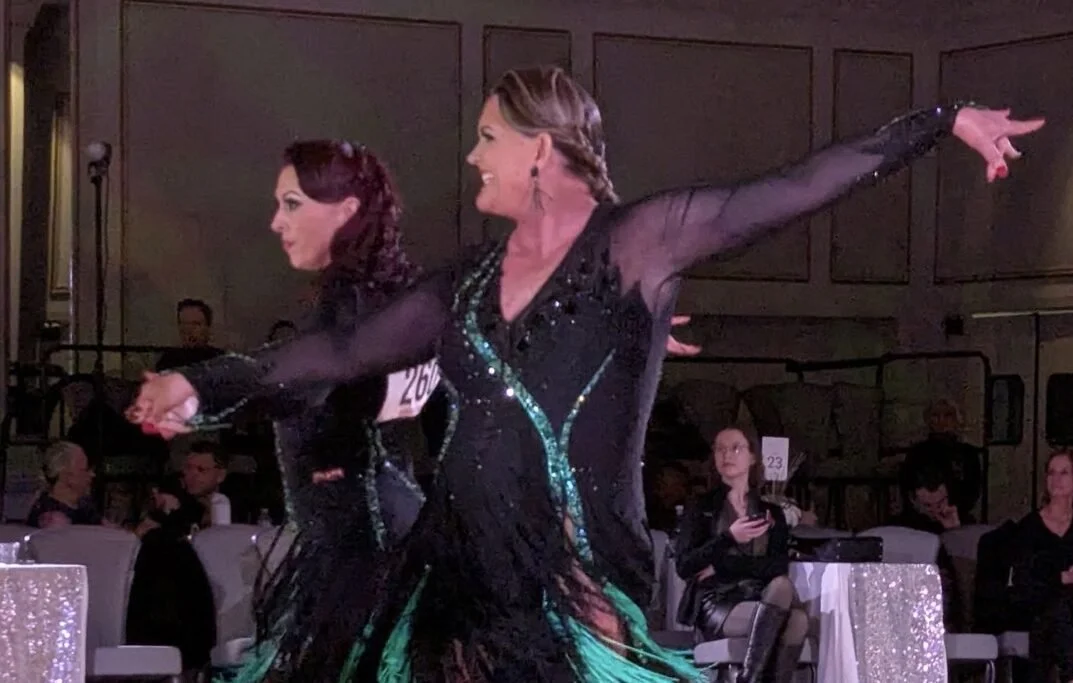
This article originally appeared on American Dancer.
By Ember Reichgott Junge. Photos courtesy of Ember Reichgott Junge.
I wanted to work with the best!
Sarah Merz was enjoying her new ballroom dance journey. She was taking lessons with several male instructors at a studio in central Wisconsin, near Wausau. Her twelve-year-old son Luke was also taking lessons at the studio with instructor Heather Wudstrack.
Then the pandemic came. The ballroom studio permanently closed. The male instructors chose to retire. Sarah’s lessons ended.
Heather, a twelve-year veteran teacher, asked her students if they would continue to dance if she started a studio of her own. Many said yes. So, she moved down the street and opened her own Legato Ballroom Studio in July 2020, at the height of the pandemic.
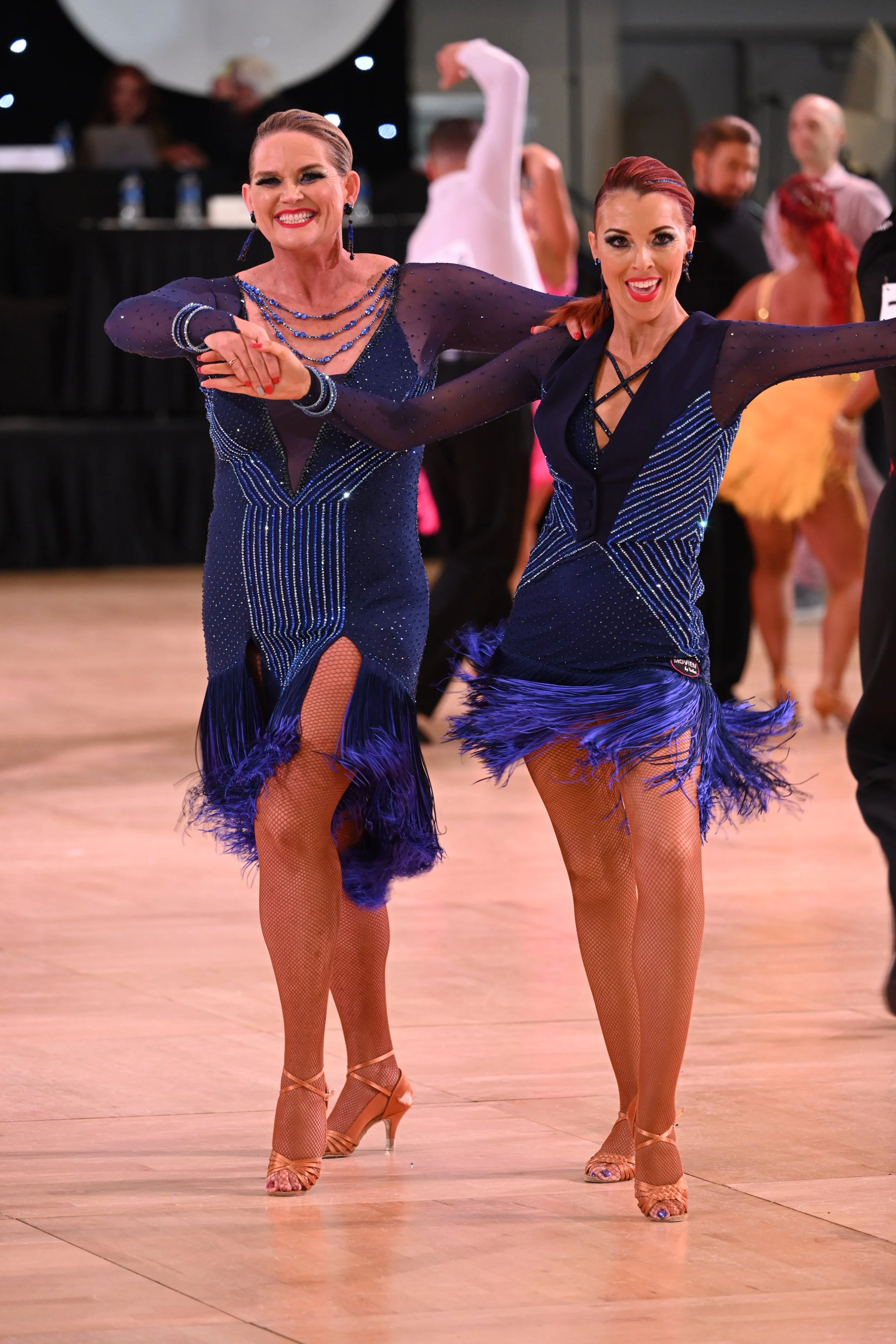
Amateur Sarah Merz & Professional Heather Wudstrack in competition.
“I took a huge leap of faith,” recalled Heather. “Looking back, it was the best decision I ever made. I was so grateful for the students and experiences I had before opening, which allowed me to be successful right off the bat.”
As for Sarah, she wanted to continue dancing, but she no longer had male instructors. “I didn’t want to be done just because I didn’t have a male partner. That’s wrong! I asked Heather—because I knew her and I saw what she had done with my son—if she would consider doing same-sex with me competitively. She embraced it with open arms. Yes, there were other options to find a male instructor. But here, Heather’s the best. I wanted to work with the best!”
Even Luke encouraged the partnership. He told Heather, “If you can get me to hold my frame and posture, I’m sure you can do a lot for my mom.”
Sarah and Heather developed a powerful partnership that has grown over recent years. Having a female instructor allowed Sarah the confidence to take on the challenges of higher levels of dance and techniques.
“Men cannot replicate the way a woman’s body needs to move in a Rumba, Swing, or Cha-Cha,” Sarah said. “There are new elements the longer you’re in ballroom dance. You have to move in a different way than what some of our male instructors can explain. Heather can explain that physiology because she knows exactly what to say, how to move it, and where it’s supposed to happen in my body. Men can make a good guess, but their bodies are not the same as ours.”
For Sarah, dancing with Heather has been a great decision both “as a competitive student and human being. It’s been incredible, to be honest,” she said.
Sarah and Heather knew they wanted to compete as a same-sex partnership, but they also knew they needed to tell a new story through their dance. They needed it to be different from the romantic love story often created in male-female partnerships.
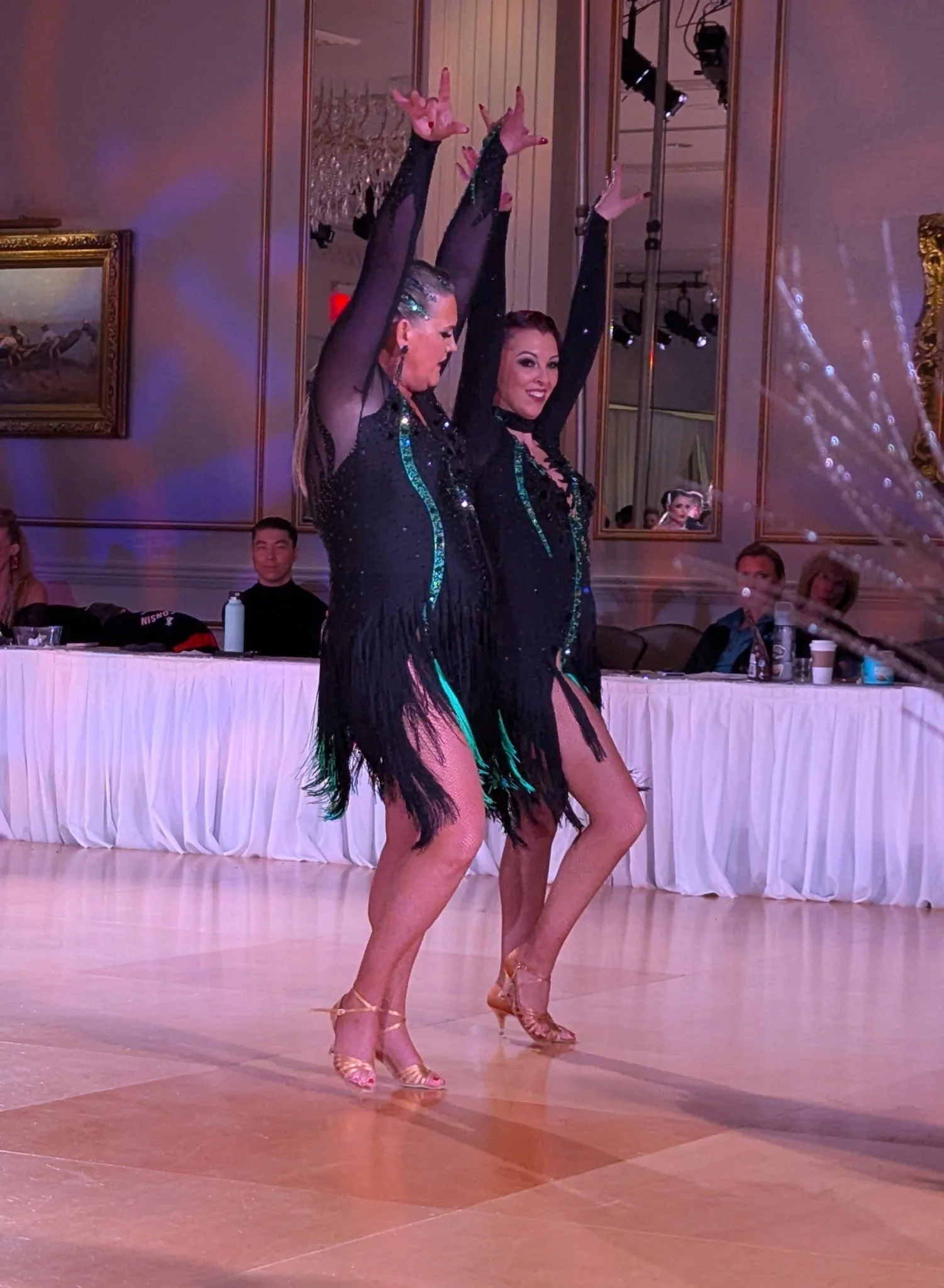
Sarah and Heather developed a powerful partnership that has grown over recent years.
“We’ve evolved in our stylistic and choreography choices,” Heather said. “At first, it was like two chicks dancing—it looked like a fad, a flash in the pan. But Sarah and I approached it from a serious competitor standpoint. We’ve invested in costumes that complement each other really well.”
For their costumes, they created matching blue dresses. This led them to be known as “the girls in blue.”
“We’ve invested heavily in choreography that showcases our movement as women versus choreography that is driven from a male-lead standpoint,” Heather continued. “People tell us they don’t like it ‘when you are trying to be a dude.’”
Heather’s partnership with Sarah in competitions became possible only after both USA Dance and the National Dance Council of America changed their rules for accredited competitions to allow same-sex partnerships. (Editor’s Note: USA Dance originally approved “same-sex divisions” in 2014. However, those were optional events that organizers could choose to offer. The 2019 change eliminated separate divisions and allowed any partnership to compete directly in the event as leader and follower, regardless of gender.) The 2019 rule changes, which stand today, offer unique benefits for female professionals like Heather. They allow female teachers to teach more lessons and enter accredited competitions to showcase their female students. Previously, professionals could coach and train same-sex students in their studios, but they were never allowed to competitively showcase their work.
Heather, 43, and Sarah, 51, have now been competing together for over six years. How have they been received on the competition dance floor?
“Sarah has had some really nice placements,” Heather said. “She was a finalist at Ohio Star Ball. It’s wonderful to see that judges are now marking her based on quality of dancing, versus giving her a straight last place when we started.”
Straight last place?
“When we first started, leading was new to me,” explained Heather. “Every good instructor should know how to lead and follow. But I never had to compete with it. There was a growth in that—in learning how to communicate well with my partner. And judges were struggling; they were like, ‘It’s two women out there, so we’re not sure how to mark that yet.’”
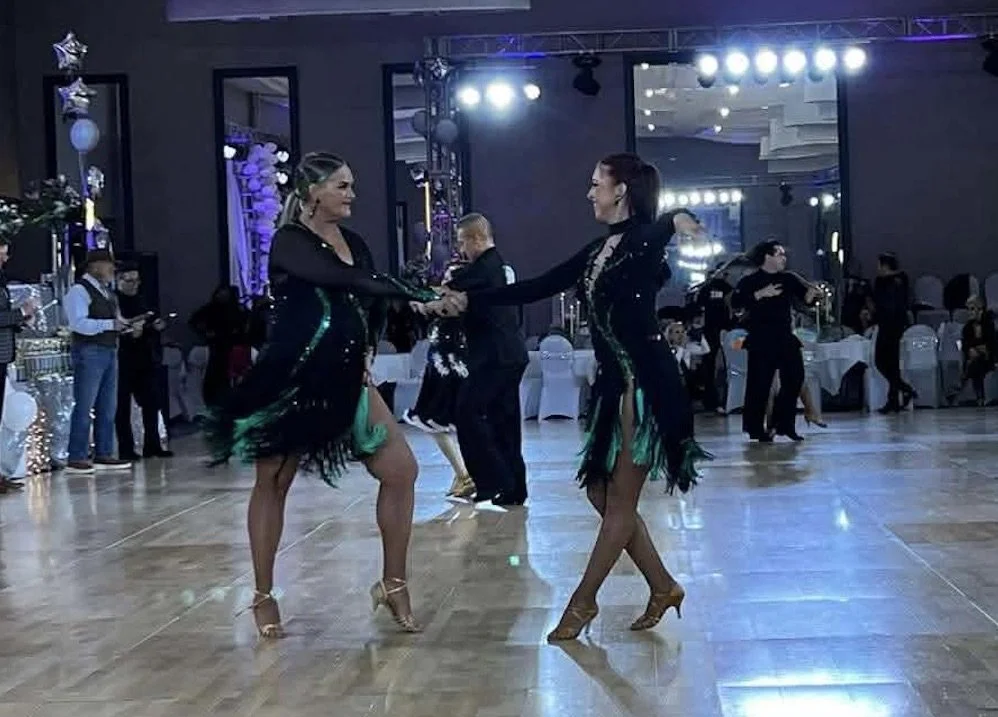
When Heather and Sarah began competing as a same-sex couple, they were a rarity. But the number of competitive same-sex couples has grown every time they’ve been on the floor. I personally saw that when I visited them last month at the showcase Heather organized near their studio as part of their Garden Masquerade Gala weekend. The audience seemed to relish cheering on the same-sex couples. Sarah did not dance, due to a recent injury, but served as Master of Ceremonies for the event.
Perhaps the fact that Heather and Sarah are high-quality dance role models is a factor in that growth, both on and off the competitive dance floor. Today, Heather’s competitive students are roughly an equal mix of males and females. And with photos of Heather and Sarah framed on the Legato Ballroom Studio walls, more amateur same-sex couples are calling their ballroom.
Heather noted that most of the partnerships are not about sexual orientation. Some want to learn the opposite role to help them become better dancers or teachers. A mother-and-daughter team took lessons for a family wedding. The mother was 80 years old.
“She left me a voice message,” Heather said with a smile. “She told me how much they were enjoying dancing because dancing improved her balance. And because dance is a repetitive movement, it wasn’t super strenuous for her. She dances in the pool to help her balance. Her daughter is just thrilled!”
I love it—mothers and daughters taking lessons together! I can’t help but think about my own mother, a former Arthur Murray instructor and jitterbug queen, who intimidated the hell out of me for years to the point that I was unwilling to dance. If I had only known while my mother was alive that same-sex dance could be a thing. How cool it would have been to partner with Mom for a few lessons when I finally decided to start dancing at age thirty-five. How lovely it would have been to share her touch and joy in something we both loved, especially as she was becoming more fragile in her aging.
Forgive me as I wipe away a tear.